The Formation of Ithaca Monthly Meeting
In 1912, Edward and Marianna Wood, the parents of Sarah Wood Oliver, moved to Ithaca and began a small Meeting in their home at 238 Linden Avenue. (A modern apartment building now stands at that Collegetown address.)
Continue reading about the Formation of Ithaca Monthly Meeting
Around 1913, the Meeting moved to Barnes Hall on central campus, where it met in one of several rooms over the years until Anabel Taylor Hall was built. In these early years, Meetings for Worship were most commonly held in the evening, at 7:00 or 7:30pm.
By 1926, the Ithaca Friends group felt it should formalize its existence. The Ithaca Association of Friends (IAF), was officially formed at a special meeting on March 7, 1926 and notice was sent to New York and other yearly meetings asking for recognition.
On February 20, 1927, a special committee sent by New York Yearly Meeting (Orthodox) visited to consult with Ithaca Friends relative to their petition for recognition. Later, on June 9, 1929, Anne Bronson and her daughter visited the Meeting from Philadelphia Yearly Meeting (Hicksite) for a similar discussion.
On March 23, 1930, the IAF decided to hold its first annual meeting, and did so on April 15. At the 1930-31 Annual Meeting, Josh Cope was named Clerk. Grace Mekeel continued as treasurer. During this year, attempts for joint meetings with Jacksonville, Perry City, and Popular Ridge were noted.
On December 7, 1937, the Ithaca Friends applied for membership as a monthly meeting affiliated with the Friends Fellowship Council. This organization had its origin in the Fellowship Committee of the AFSC. Founded in 1933, its primary purpose was to foster an increased interest in Quakerism throughout the US and to draw all Friends groups into closer fellowship. Monthly meetings organized in New York under the Friends Fellowship Council included Big Flats, Buffalo, Elmira, Ithaca, Jamestown, Mt. Vernon, Riverside, and Rockland.
The formal organization for Ithaca Monthly Meeting under the Friends Fellowship Council was approved on February 27, 1938.
Thus, although Friends in Ithaca had met independently since 1912, Ithaca Monthly Meeting formally dates from 1938. It was at this time that IMM secured the right to accept members into the Society of Friends.
Excerpted from a history compiled by Tom Brown in 2007
Ithaca’s Other Meetinghouse: the Hector Meetinghouse on Perry City Road
The structure that we call the “Hector Meetinghouse” (5066 Perry City Road) was built around 1905. The first Hector Meetinghouse was built in 1826 in Hector, NY, on the east side of Seneca Lake.
Continue reading about Hector Meetinghouse
In 1857, Hector Meeting was divided by a schism in Quakerism: one portion of the Meeting broke off from the Wilburites and affiliated with the Otisites. (A number of conservative meetings in the Northeast experienced splits from the larger Wilburite group during this time. There were Otisite and Kingite factions; others identified themselves as Primitive and Evangelical meetings. A restoration of the Otisites and Wilburites occurred in 1881.)
As a result of that schism, part of the original Hector Meeting split off and formed Perry City Meeting (that still meets a few miles down the road from the present Hector Meetinghouse).
This left the original Hector Meetinghouse too big for the remaining the membership, and in 1864 they began to meet in a little schoolhouse instead.
Eventually, the schoolhouse became too small and a new Meetinghouse was built just across the road from the schoolhouse sometime between 1903 and 1906. Although not located in Hector, the original Meeting name was kept; hence the “Hector Meetinghouse” in Jacksonville.

The elevated area in the Hector Meetinghouse is known as a “facing bench.” Historically, those who had been recognized as having a gift for vocal ministry sat in this area, but this practice is no longer observed.
Hector Meeting was no longer in existence when Ithaca Monthly Meeting took possession of the building in 1978. (Ithaca Meeting began well after the construction of the Hector Meetinghouse: Ithaca Friends became an established monthly meeting with the ability to accept members into the Society of Friends in 1938.)
Three former Hector Meeting members eventually became IMM clerks: Amy Grace Mekeel (clerk from 1947 through 1950), Theodore Oliver (1950-52) and Sarah Oliver (1954-56 and 1964-66). Indeed, Theodore Oliver was Hector Monthly Meeting’s clerk from 1939-50 and, in 1950, he asked to be relieved of his clerking duties for Hector Meeting because he had been appointed Clerk of Ithaca Monthly Meeting.

Ezra Cornell was Read Out of Meeting
The letter below was penned by Ezra Cornell in response to a letter from his home Meeting in Westchester County. Ezra had married a Methodist (Mary Anne Wood) in 1831. Marrying a non-Quaker was a violation of Quaker rules at the time and grounds for being “read out of” or “disowned by” a Meeting. This was the fate of Ezra.
Read more about Ezra Cornell
Friend Nehemiah Merritt,
I received a letter from thee some days ago and am sorry I have not had time before now to answer it. This is a very busy season of the year with us on account of the plastering business and I must offer that for an excuse.
Thou art a stranger to me but thee hast informed me of no more than I expected to hear. If the Meeting feel that they have done right, I have no reason to complain—And if I feel than I have done right I don’t see what reason they have to complain. I have not disobeyed any regulations have bound myself to follow. I have always considered that choosing a companion in life was a very important affair and that my happiness or misery in this life depended on the choice and for that reason I never felt myself bound to be directed in the affairs by any higher thing than my own feelings. I have done as reason directed me and I feel as though I had done right.
I am satisfied at any rate with my choice. But as they have severed the member from the body, it must be lost to them. I hope it will not wither and decay… perhaps it may flourish and increase in strength after it recovers from the stress caused by the separation from the body.
Thee says thee has a desire to see me. I shall be extremely glad to receive a visit from thee any time when the health of thy family will permit. I remain a well wisher of the Society.
Ezra Cornell
Ithaca, 24th of 2nd month, 1832

A Brief History of IMM’s Burtt House
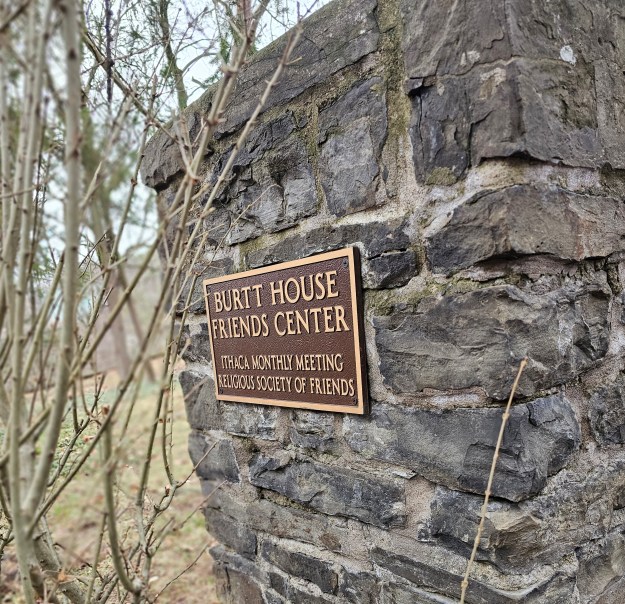
The house at 227 Willard Way was bequeathed to the Meeting from the estate of Ned and Marjorie Burtt, beloved members of Ithaca Monthly Meeting, in 1989. (The Burtt’s had been active members of our Meeting and had hosted many Meeting events at their home from the 1950s until their deaths.)
Read more about the Burtt House
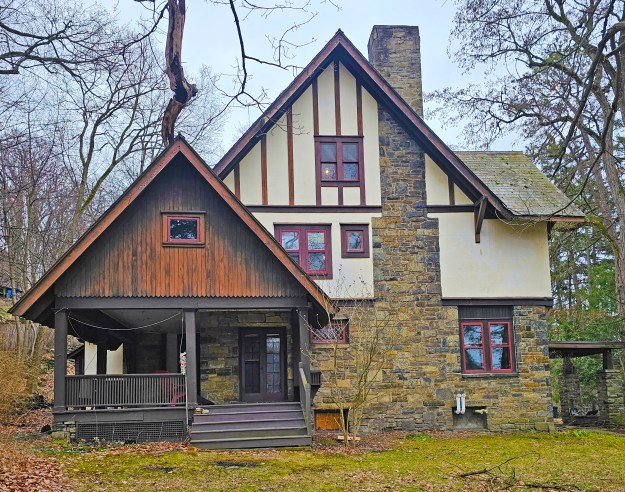
Since the bequest, the Burtt House has been used by the Meeting for different purposes. Before Meeting acquired the Third Street Meetinghouse in 2011, Meeting for Worship was held on Cornell’s campus and the Burtt House was heavily used as a venue for other gatherings, such as committee meetings, special programs, and social gatherings like Talent Night and dish-to-pass dinners.
At the same time, the Burtt House also functioned as a home. A “Friend-in-Residence” oversaw scheduling the building’s use and attended to some of its maintenance needs. For many years, bedrooms were rented to long-term residents interested in living in “a small intentional community that lives … in a manner consistent with Quaker teachings” and lodging was available for short-term sojourners. Across the decades, the Burtt House has also served as a home to several refugees.
In the late 1990s, Meeting explored adapting the Burtt House into a Meetinghouse, commissioning an architectural study for a significant addition. This proposal did not move forward, with Friends raising concerns about the acute shortage of parking on the narrow, dead-end street and the risks of having children convened at the rim of the gorge.
Around the same time, the City of Ithaca approached the Meeting to purchase 1/3 acre of the overlook land for use as a park. Meeting agreed, selling the parcel for $71,000.
Once Ithaca Monthly Meeting acquired the Third Street Meetinghouse as its home in April of 2011, the relationship between Meeting and the Burtt House began to change. While Meeting still maintained a Friend-in-Residence at the Burtt House, the building was no longer central to Meeting life. Several long-time members of the IMM community still felt a strong connection to the Burtt House, but many newer Friends had never even seen the building. The building’s role in the life of the Meeting was becoming unclear.
A new sense of purpose emerged in 2016 as some Friends engaged in anti-racism work. That February, Meeting invited Angela Hopkins, then a Friend-in-Residence at Pendle Hill, to stay at the Burtt House while we jointly discerned next steps in this work. In October 2016, Meeting approved designating the Burtt House as the home of a new Friends Center for Racial Justice (FCRJ) under Angela’s direction.
Even with the creation of the FCRJ, questions relating to Meeting’s ownership and stewardship of the building persisted. In late 2021, Meeting took up the issue of our relationship to the Burtt House anew, establishing the Burtt House Working Group “to facilitate discernment around next steps” in relation to the property.
Following several Working Group listening sessions across 2022 and 2023, the sense of the Meeting minuted in April 2024 was that we were “prepared to release the Burtt House.” Then in September of that year, Meeting decided we would undertake a plan to sell the Burtt House, with a goal of placing the house on the market in early 2026. The Friends Center for Racial Justice was invited to stay in the house until the end of 2025.
In discerning right-use of the Burtt’s bequest, Friends have been mindful of the wishes of Ned and Marjorie. The Burtts provided Trustees with a letter in 1981 indicating that they would bequeath their home to Ithaca Monthly Meeting. The letter includes the following:
“The Meeting is free to do whatever it sees fit with the bequest. We write this statement simply to express a few thoughts that are in our minds and hearts as we make the bequest. It is our hope that the property will be useful as a Friends Center and the headquarters for Friends’ activities in the Ithaca area. We have always wanted our home to be a harbor for peace, renewal, and refreshment to all who enter it. […]
“Our experience indicates that several hours per week of work or supervision are likely to be needed if the buildings are to be maintained efficiently and kept attractive in appearance.
“There are facilities for the First Day School. One room or more could become special headquarters for the Young Friends. The Meeting library can easily be added to the books that we leave in the house…. There would be space for a Meeting office… One or more rooms on the second floor could be used for guests visiting overnight. […]
“Presumably the Meeting will wish to make the facilities of the house and lookout available to other religious groups on the Cornell or Ithaca College campus or downtown, whenever there is no conflict with the needs of the Meeting. […]
“Our experience with the Hector Meeting House and the Oliver House [a house in Collegetown donated by the Oliver family and subsequently sold by the Meeting] have made us aware that there are many practical problems involved in owning and maintaining property. At some time in the future the Meeting might find ownership of our house a burden rather than a blessing. In that event it could be sold, or turned over to some organization whose purposes are akin to those of the Society of Friends.
“We are deeply grateful for the blessings that have come to us through the Meeting. May our home continue to express in the future our thanks and our love.”
While the Burtt House itself did not become Ithaca’s Meetinghouse, the Burtt’s bequest was still essential in Meeting finding a home: the $71,000 garnered the sale of “overlook land” to the city of Ithaca was used, two decades later, in the purchase of the Third Street Meetinghouse, making the Burtts the largest donors to that acquisition.IMM_news_2010_nov.pdf
- Marin Clarkberg, December 2025
The Very Long Search for a Meetinghouse for Ithaca Monthly Meeting
Ithaca Quakers first gathered at a family home (238 Dryden Road) in Collegetown in 1912. Within a year or so, Meeting for Worship moved to Cornell University facilities–Barnes Hall initially and then Anabel Taylor Hall after its construction in 1952–where we stayed for nearly 100 years, until 2011.
Read more about the search for a meetinghouse
The accommodations at Cornell provided Meeting with sufficient space for worship on Sundays at a very modest cost and without any real property management responsibilities. While some Friends found this arrangement to be ideal, others yearned for a physical home for our Meeting community: a place to gather, host meals, and store materials.
In 1948, for example, when Meeting was anticipating the future move to Anabel Taylor Hall, “Young Friends suggested that IMM build a meetinghouse—that there would be concern about meeting in the new building to be constructed which would be a war memorial.”
In 1952 with the move impending, “The March Monthly Meeting was devoted to the question of whether to move to Anabel Taylor Hall. The question of finding an alternative site was discussed. Ned and Marjorie Burtt offered IMM a piece of their property overlooking the falls if Meeting chose to build a meetinghouse.”
A building fund was established in 1957.
In 1959, the Clerk, Ned Burtt, led a Building Committee that described the requirements for a Meetinghouse as including:
- 1000-1200 square feet room for Meeting for Worship
- 120 square feet minimum for a kitchen
- 700 square feet total for six rooms for First Day School
- 2 bathrooms
- Parking for 10 cars
(This description is remarkably close to a description of the Third Street Meetinghouse today!)
When Ithaca Monthly Meeting took possession of the Hector Meetinghouse in 1978, there was some consideration of whether the building could serve as IMM’s Meetinghouse, but this idea was rejected.
In December of 1978, longtime Friend Theodore Oliver died, leaving his house at 238 Linden Avenue–the house at which Ithaca Quakers first convened in 1912–to Ithaca Meeting.
Having recently taken possession of the Hector Meetinghouse, Ithaca Meeting reflected in the minutes of the Annual Meeting from May 1979, “We who have never owned any property have, within the year, become owners of two!”
Meeting formally accepted the Oliver bequest in June of 1979, but noted that it “does so with the intention to sell [the house] rather than hold it for use as an asset of the Meeting.” In November of that year, the Oliver House sold for $52,000. (While this “Oliver fund” money was held separately from the building fund, the Oliver House proceeds would eventually be used for acquiring the Third Street Meetinghouse in 2010.)
As noted above, the Burtt House had been held out as a possible home for the Meeting since at least 1952. Following Ned Burtt’s death in 1989, the bequest of his home moved that question to the front burner. In the decade that followed, Meeting explored adapting the Burtt House into a Meetinghouse, commissioning an architectural study for a significant addition. Friends were divided. While some embraced moving into the beloved Burtt House at last, others felt that the property was just too small, that the location could not offer sufficient parking, and that the house’s location on the top of a cliff posed risks to children.
The search for a home continued. Then in the Spring of 2001, Meeting purchased an undeveloped, 8-acre parcel of land on Slaterville Road/Route 79 just west of the Commonland housing development. With aspirations to build a custom Meetinghouse of our own, Meeting formally laid down the search for alternative locations as well as the idea of adding onto the Burtt House.
Again, architects were engaged and an initial plan was brought forth in 2006. And again, the Meeting was divided. The proposed Meetinghouse was large and very expensive, with initial cost estimates in the range of $950K to $1.3M. (We had a little over $200K in our building fund saved up.) It was clear that a project of that scope would necessitate selling the Burtt House, and some Friends felt that this was an unacceptable sacrifice. Other critiques of the project included the fact that the property was in a suburban area not conducive to bus or pedestrian access, and that such a significant construction project adjacent to the Six Mile Creek conservation area was not good environmental stewardship. Many Friends experienced this time as a period of significant conflict within Ithaca Monthly Meeting, with one part of the Meeting eager to move forward with a building and another part of the Meeting committed to retaining the Burtt House.
Ithaca Meeting remained at an uncomfortable standstill on the Meetinghouse issue for years, but something was nudged loose in the summer of 2009. A beautiful old church–most recently a Masonic lodge–on West Dryden Road was for sale at an affordable price. On August 22, 2009 there was a special Called Meeting for Worship at this property to help us decide whether IMM should purchase it. Many found the experience uplifting, but the building was far from Ithaca and the Meeting’s membership.

Still, as our Clerk described in a subsequent newsletter article, throughout the West Dryden Road consideration, “We shared openly with each other and listened with respect. These qualities were often absent in Meetinghouse discussions from several years ago.” Clerk Steve Mohlke summarized, “We concluded our discussions [of the property] with the question: If not this, then what?”
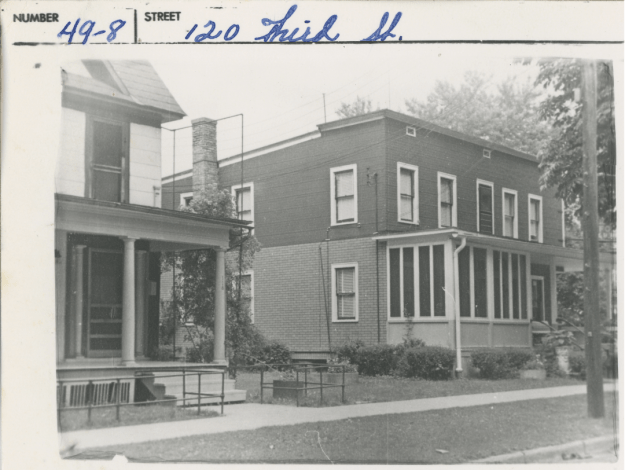
Almost as soon as that article was written, in the middle of January 2010, Meeting’s realtor Christa Bissell contacted Friends with information that the building that was formerly the home of the Pangea restaurant was listed for sale at $180,000. Christa wrote, “It’s kind of a mess inside and needs work, but certainly right downtown & has parking. One of the problems is that this seller needs to sell quickly, so not sure your group would have enough time to consider it.”
Three viewings of the property were arranged in February, and at a special Called Meeting on Sunday, February 21, 2010, Friends found themselves to be in unity with a proposal to move forward with the property.
Ithaca’s Quakers had at last acquired [the makings of] a Meetinghouse.
Over the next year, the building was gutted and entirely refurbished according to plans drafted by Claudia Brenner, architect.
As noted in the March 2011 Newsletter:
The first Meeting for Worship ever to be held in a Quaker meetinghouse in Ithaca is coming soon. It’s impossible to guarantee a move-in date right now, but we are currently planning to convene for our first First Day in our own building on April 10th.
If we are in fact able to move in that weekend, Ministry and Worship is planning for a 24-hour Meeting for Worship to begin Saturday, April 9th at 11am. This would be an opportunity to commemorate this historic event and to establish our presence in our new home.
The land out on Route 79 was sold in June 2011 to the City of Ithaca, with the proceeds going towards the Meetinghouse fund.