The Project Abundance garden is growing beautifully! When Steve and I recently stopped by to check on it, he took these photos.
In Friendship,
Amala
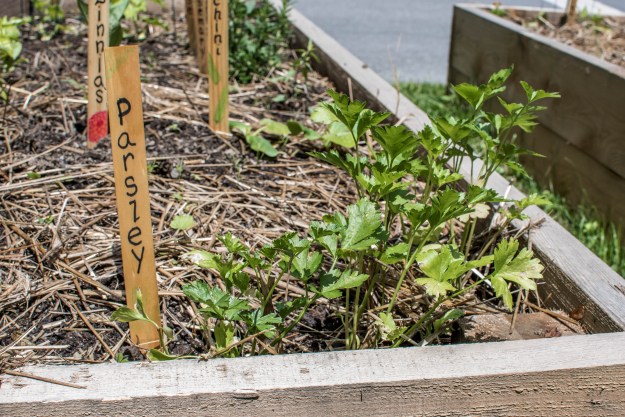

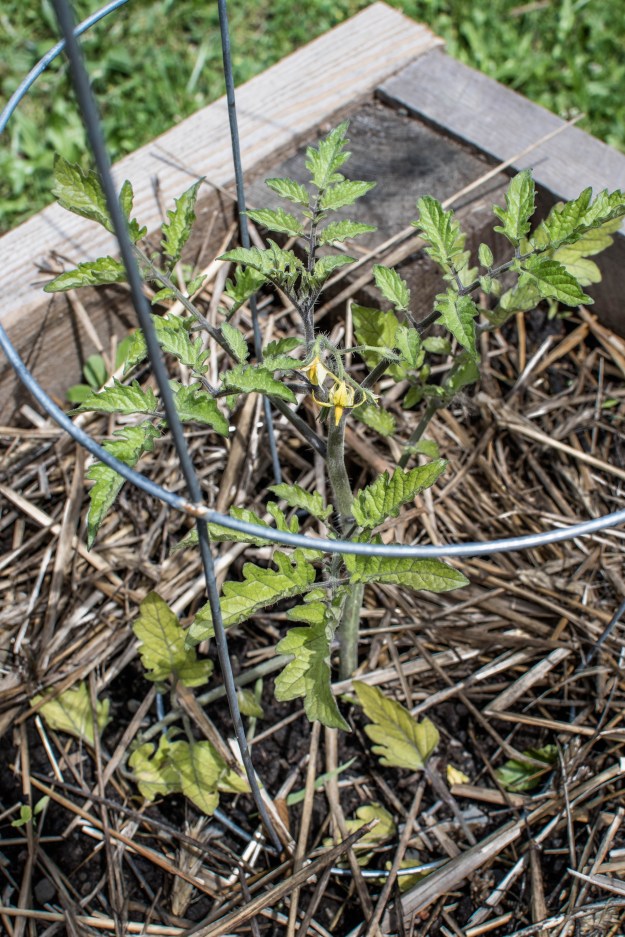
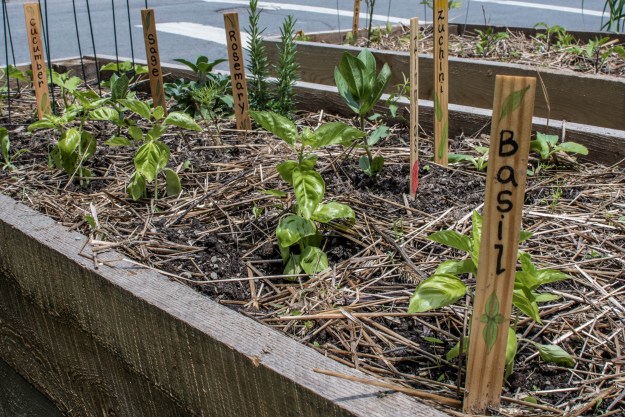


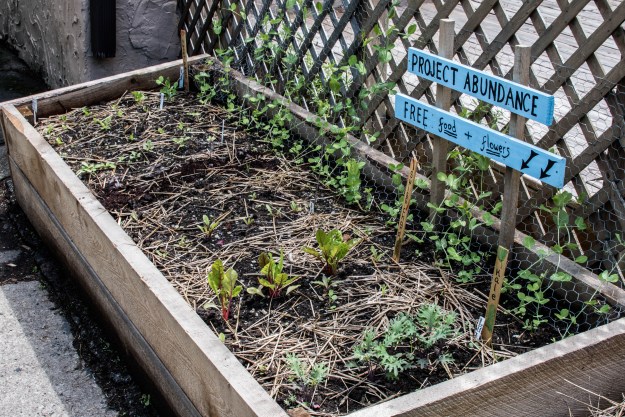
The Project Abundance garden is growing beautifully! When Steve and I recently stopped by to check on it, he took these photos.
In Friendship,
Amala

If you’ve attended Meeting for Worship in person at our Third Street Meetinghouse, or just been past there recently you probably noticed several raised garden beds installed on the tree lawn and along the fence. What you’re seeing is the beginning of Project Abundance. Thanks in part to a mini-grant from Sustainable Tompkins, Ithaca Monthly Meeting’s Earthcare Committee has launched Project Abundance to “make real the sense of abundance nature offers us – and incorporate the sacredness of nature and the miracle of growth more within neighborhood communities and within our own congregations” (from the grant application). Food and flowers growing in the raised beds will be available for anyone in the neighborhood to pick and use for free.
The originating purpose of Project Abundance, which Earthcare discussed in fall of 2020, was to get past the narrowing and diminishing mindset of the Trump presidency and the pandemic. When they began researching how to implement the idea they discovered an already existing network of neighborhood raised garden beds in the Northside neighborhood, ranging from a park near the Science Center, to Conley Park, to a permaculture park near the Cascadilla Creek. Leading this effort was Josh Dolan of Cornell Cooperative Extension, and Solidarity Gardens, a network of area gardeners. Earthcare looked for ways to plug into this network and expand on their vision.
Members of the Earthcare Committee reached out to the Northside Neighborhood via their listserv and solicited thoughts on what to grow in these raised garden beds. Suggestions included greens (kale, collard greens, chard, lettuce), herbs (thyme, basil, parsley) and flowers (calendulas, zinnias, lavender). The aim of the project is to encourage a sense of abundance and delight in growing food and flowers. In addition, Earthcare wants to see if we can create a model that other religious organizations can adopt.

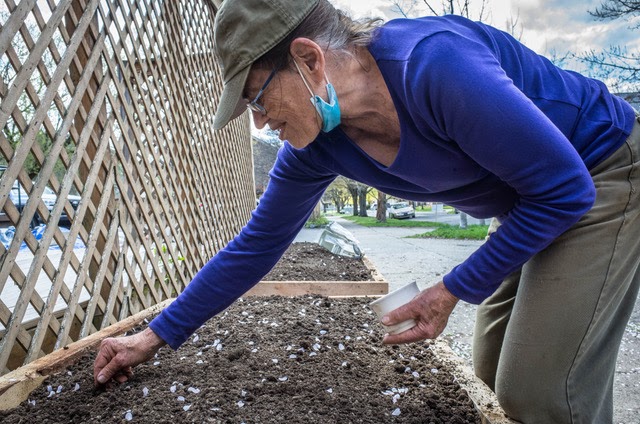

Earthcare Committee hopes this physical and practical example will expand love of nature and a concern with the human destruction of nature within Ithaca Meeting. They also hope to create a further connection between Ithaca Meeting and members of the Earthcare Committee, and the Northside neighborhood. The committee hopes this project will blur those boundaries between our Meeting and the neighborhood, and enhance Quaker ideas of the Spirit in everyone and everything.
The project is led by Betsy Keokosky and involves the work of several Friends in our Meeting, including Margaret McCasland, Jim Grant, Miguel Piery, Steve Soblick. If you would like to help with this project, get in touch with Betsy.
— Garry Thomas
At his sentencing on October 15, in Federal Court in Brunswick, Georgia, Kings Bay Plowshares activist Patrick O’Neill told Judge Lisa Godbey Wood: “This court, by its refusal to consider the lawlessness of weapons of mass destruction, is essentially declaring the end of the world to be acceptable.”
Just days later, on October 24, Honduras became the 50th nation to sign the UN Treaty on the Prohibition of Nuclear Weapons, this the threshold that was required in order for the treaty to become international law. The law requires signatories never “to develop, test, produce, manufacture or otherwise acquire, possess or stockpile nuclear weapons or other nuclear explosive devices.” It is important that the treaty calls for the prohibition of nuclear weapons rather than merely their non-proliferation. Plowshares activists, who have long felt the United States’ possession of a nuclear arsenal to be illegal as well as immoral, will soon have the backing of the United Nations. The treaty goes into effect on January 22, 2021.
The International Campaign to Abolish Nuclear Weapons (ICAN) was awarded the 2017 Nobel Peace Prize for its “ground-breaking efforts” to achieve this very treaty to prohibit such weapons. Local Back from the Brink activists brought Dr. Ira Helfand, a member of ICAN’s International Steering Committee and co-chair of the International Physicians for Social Responsibility to Ithaca in March 2019. He ended his presentation at St John’s Episcopal Church saying, “It is not helpful to think, as a large percentage of the US population does, ‘In my heart I don’t believe it can happen here,’ and then go about our daily lives. That is what happened during the Holocaust ‘when it did happen here’.” Since his Ithaca visit, Helfand has added his name to the global petition to drop the charges against the Kings Bay Plowshares 7 alongside more than 100 other notables.
Ira Helfand commended Back from the Brink as the type of initiative that is required, saying “It is parallel to the Green New Deal in importance.” Four states and 50 cities and towns in the US, including the City of Ithaca (2018) and the Town of Lansing (2019), have adopted resolutions supporting Back from the Brink’s policy solutions: renounce first use; end sole authority of the president to order a nuclear attack; end hair-trigger alert; cancel enhanced weapons’ development; and press more nations to sign the UN Treaty on the Prohibition of Nuclear Weapons.
Significantly, none of the countries possessing nuclear weapons – the US, Russia, UK, China, France, India, Pakistan, North Korea and Israel – have signed the treaty. However, in a statement following Honduras’ becoming a signatory, ICAN said: “States that haven’t joined the treaty will feel its power too – we can expect companies to stop producing nuclear weapons and financial institutions to stop investing in nuclear weapon-producing companies.”
Our work is not done.
This article was first published in the Winter 2020 issue of The Magnificat, the Ithaca Catholic Worker community newsletter.
Elizabeth Schneider
I asked Angela to sit down with me and share what the Friends Center for Racial Justice (FCRJ) has been doing this year, so it could be shared with our Meeting. I wanted to do this because I observe that Angela does not compartmentalize the work of FCRJ and racial justice. That work is part of her day-to-day life, wherever she goes. Below is a quick review of what she was up to in this past year.
The start of 2020 seems far in the past. It was before covid-19 when travel was safe. For Angela it meant a chance to go to Florida for a visit with family, and also experience the warm sun. While she was there, the Southeast Regional Gathering of the Friends World Committee on Consultation (FWCC) was meeting in Miami, and she took the opportunity to join them. Part of the gathering was conducted in a Spanish-speaking Friends Church. Angela found it comforting—it reminded her of the many languages and cultures which make up the Religious Society of Friends (RSF). Participants were from programmed and unprogrammed Meetings, and it provided an opportunity to talk with those having problems with racism.
In January 2020 FCRJ was a cosponsor of the film that Carolyn Kenyon, as part of the Finger Lakes for New York Health, brought to Cinemapolis about how Medicare was used to mount a coordinated effort that desegregated thousands of hospitals across the country. The film was well attended and followed by an informative panel discussion.
In February Angela started her drive back to Ithaca. She stopped to meet with the Southern Appalachian Yearly Meeting and Association (SAYMA) in North Carolina. In 2019 FCRJ had been invited to help resolve a racial justice concern through a listening project. This was her second in-person visit with SAYMA. In 2019 and 2020 there were also phone meetings where Angela was accompanied by a member of FCRJ’s Coordinating Committee to continue the listening project to address this concern. Time was given, in hopes that both parties could hear each other, understand the root of the problem, and clarify the Quaker concerns that are rising.
At the end of February 2020, the first workshop/event of the spring was held at FCRJ’s home base: Corporate Apologies/Corporate Forgiveness: Steps toward Building an Equitable Religious Society of Friends. Participants looked at what constitutes an apology. There are historical realities of broken treaties and broken promises. What makes our words and actions now different from the past? Participants left carrying that query.
Then, boom, COVID-19 arrived, and the remaining planned workshops were cancelled. But the work of FCRJ continued. The solidity of FCRJ may come from the fact that all the members of NYYM’s Task Group on Racism are part of the FCRJ Coordinating Committee—Friends who are used to working with each other on racism within the RSF. The visiting program of that Task Group lead to the formation of FCRJ. And Angela has a habit of bringing the concern of racial justice with her wherever she goes.
Angela’s and FCRJ’s involvement in the Meetings and Committees below is about addressing the issue of racial discrimination in the RSF. Addressing issues of equity needs to be part of every aspect of committee work, not just that of the Black Concerns Committee. We all need to have concern for how we handle our finances, who gets heard, and who is represented. Angela’s and FCRJ’s involvements include many aspects of Quaker life:
Interestingly, Angela notes that this period of COVID-19 is having some positive effects: our virtual Meetings for Worship, committee meetings, and social gatherings can include Friends at a distance, caregivers for the young and the old, shut-ins, and young people (who are very comfortable on Zoom!).
The new year brings opportunities. You will be hearing from FCRJ about “Table for Ten”—small, focused working groups. The gatherings can be virtual or in-person (once COVID-19 has fled).
I hope this brief article gives you a sense of the ongoing work of FCRJ that I have gotten a chance to hear about when I visit with Angela weekly, either in person or on the phone. Hope to see you (or hear you) at a Table for Ten.
Sunday, August 9, 2020 at 6:00 pm (EDT)
There has been a tradition of Friends and others to take time to remember the dropping of the first atomic bombs in 1945 on Hiroshima (August 6) and on Nagasaki Japan (August 9) with a silent vigil around the Peace Pole in front of the Friends Center for Racial Justice (FCRJ). This year marks the 75th anniversary of these bombings. This is a vigil of mindfulness and remembrance of the thousands of persons who were killed 75 years ago at the instant of the blasts, those who later died from their injuries, and those who suffered from their injuries.
We are proceeding with plans to vigil together in a blended manner. Some Friends will meet in person around the Peace Pole at the FCRJ and socially distance so that those in attendance can feel safe while being apart and wearing a mask. Some Friends will join via Zoom (link below). If you plan on attending this Vigil in person, please e-mail Elizabeth Schneider to reserve a seat.